
Introduction
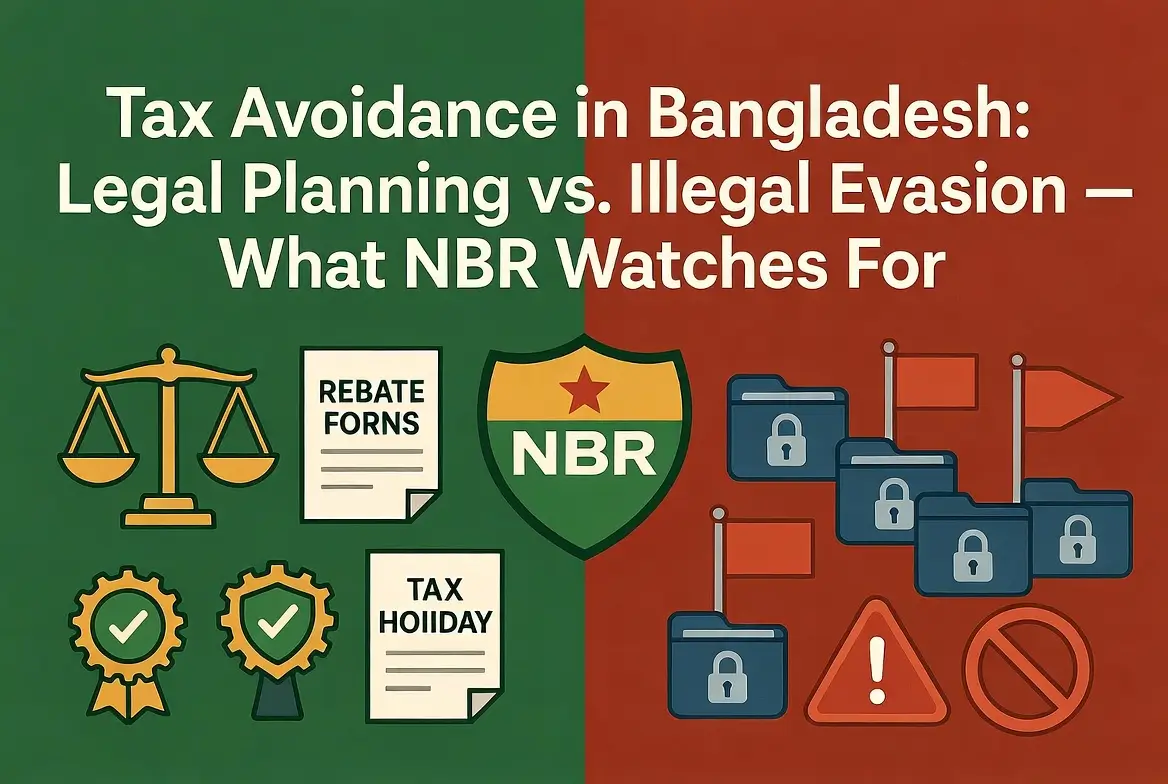
Tax avoidance and tax evasion carry vastly different legal and ethical implications. Tax avoidance — using legitimate means to reduce tax liability within the bounds of the law — is a right of every taxpayer. Tax evasion, by contrast, involves deliberately underreporting income, falsifying records, or making fraudulent claims. In Bangladesh, where the tax-to-GDP ratio remains critically low, understanding this boundary determines whether a taxpayer is a prudent planner or a target for NBR prosecution.
-
The Scale of Tax Evasion in Bangladesh
Bangladesh’s tax-to-GDP ratio stood at only 7.4% in 2024 — far below the Asia-Pacific average of 19.5%. This is primarily attributed to a narrow taxable base, pervasive tax evasion, weak enforcement, and a dominant informal economy that evades formal assessment. This constrains fiscal capacity for public services and infrastructure, prompting ongoing structural reforms.
-
What Is Legal Tax Avoidance?
Legal tax avoidance involves structuring business affairs in ways permitted by law to minimise tax liability. Under Bangladesh’s tax framework, this includes:
- Claiming investment tax rebates for eligible investments in government securities, mutual funds, and approved financial instruments
- Using tax holidays and incentives for priority sectors — export-oriented units, economic and hi-tech parks, power and infrastructure, RMG, backward linkage, and IT/ITES — through reduced tax rates, accelerated depreciation, VAT exemptions, and customs concessions
- Timing income recognition and expenses to optimise within legal limits
- Structuring cross-border transactions with proper transfer pricing documentation
-
What Constitutes Tax Evasion?
Tax evasion is a criminal offence under the Income Tax Act, 2023. Common methods that NBR’s intelligence units actively monitor include:
- Underreporting of income or turnover in annual returns
- Submission of fictitious invoices or inflated expense claims
- Non-disclosure of offshore income or foreign assets
- Failure to deduct or deposit withholding tax (TDS/VDS) on prescribed payments
- Suppression of actual sales in VAT returns to reduce output tax liability
-
Governance, Corruption, and Structural Challenges
Political interference and inadequate institutional reform further undermine enforcement. Corruption diverts resources and distorts incentives for honest compliance. The International Growth Centre has noted that corruption’s drag on revenue mobilisation perpetuates fiscal deficits and economic inefficiencies. Experts warn that without addressing root governance flaws — such as simplifying complex tax laws that create rent-seeking opportunities — even digital reforms may fail to yield the desired results.
-
NBR’s Enforcement Arsenal
NBR has strengthened multiple intelligence units — including VAT intelligence, customs intelligence, central intelligence, and tax intelligence — to recover evaded revenue. The focus is explicitly on stopping revenue leakages rather than harassing compliant taxpayers. Additionally, the shift to risk-based, automated audit selection means that evasion patterns previously missed through manual selection are increasingly being flagged through data analytics.
-
Penalties for Tax Evasion
Non-compliance with NBR rules attracts significant consequences: late filing penalties starting from BDT 5,000 escalating with delays, additional tax on undisclosed income, interest on late payment, and in serious cases, criminal prosecution. Businesses that miss withholding tax deadlines face disallowance of the related expense claim as well as penalty and interest obligations.
-
Transfer Pricing — A Growing Area of Scrutiny
Transfer pricing is witnessing increased attention from tax authorities. Where a taxpayer has related-party cross-border transactions above NBR’s monetary thresholds, maintaining a Transfer Pricing Local File is mandatory. This must include a functional analysis, comparable transactions, pricing policy, and intercompany agreements.
-
Conclusion
Every taxpayer in Bangladesh has the right to organise their affairs to minimise tax within the law. However, the line between avoidance and evasion is bright — and NBR’s increasingly automated and intelligence-driven enforcement mechanisms are closing the gap for those who cross it. The best protection is a robust compliance culture: accurate records, timely filings, proper withholding, and transparent documentation of all tax positions taken.
References
- Grokipedia. “Taxation in Bangladesh.” February 2026.
- Tahmidur Rahman Remura Wahid (TRW). “NBR Tax & VAT Compliance — Incentives and Avoidance.” February 2026.
- Bangladesh Sangbad Sangstha (BSS). “NBR Chairman Stresses on Expanding VAT, Income Tax Base.” December 9, 2025.
- Sun Consultancy. “Tax Compliance in Bangladesh: NBR Rules, Income Tax Regulations.” December 2025.
- Tahmidur Rahman Remura Wahid (TRW). “Transfer Pricing Requirements under NBR Rules.” February 2026.
Disclaimer: This article is for educational and informational purposes only and does not constitute legal or tax advice. Always consult a qualified tax professional.