
Introduction
Income tax is the cornerstone of Bangladesh’s direct tax system and a primary revenue source for the government. Administered by the National Board of Revenue (NBR), income tax is levied on earnings of individuals, firms, and corporations operating in or deriving income from Bangladesh. This article provides a structured, up-to-date overview based on the Income Tax Act, 2023 and the Finance Ordinance, 2025.
-
Who Administers Income Tax?
The National Board of Revenue (NBR) is the central authority overseeing tax compliance in Bangladesh. It manages mandatory registration through Taxpayer Identification Number (TIN) issuance, periodic return filing, and withholding tax deductions at source, with non-compliance attracting penalties under the Income Tax Act, 2023.
In May 2025, NBR was restructured into specialised divisions covering income tax, VAT and excise, and customs — a modernisation effort aimed at improving collection efficiency and reducing administrative overlap.
-
Income Year and Filing Deadline
The income year in Bangladesh runs from 1 July to 30 June. Individuals must file annual income tax returns by 30 November following the end of the income year. Individuals may apply for a 90-day extension from the Commissioner of Taxes, and NBR may grant a general extension of up to one month.
-
Who Must File a Return?
You are required to file an income tax return if any of the following apply:
- Your taxable income exceeds the tax-free threshold
- You were assessed in any year within the immediately preceding three years
- You are a shareholder director, executive employee, partner of a firm, or government servant
- You have exempted income or income subject to a reduced tax rate
- You are a non-resident with a permanent establishment in Bangladesh
-
Tax Rates for Individuals (AY 2025–26)
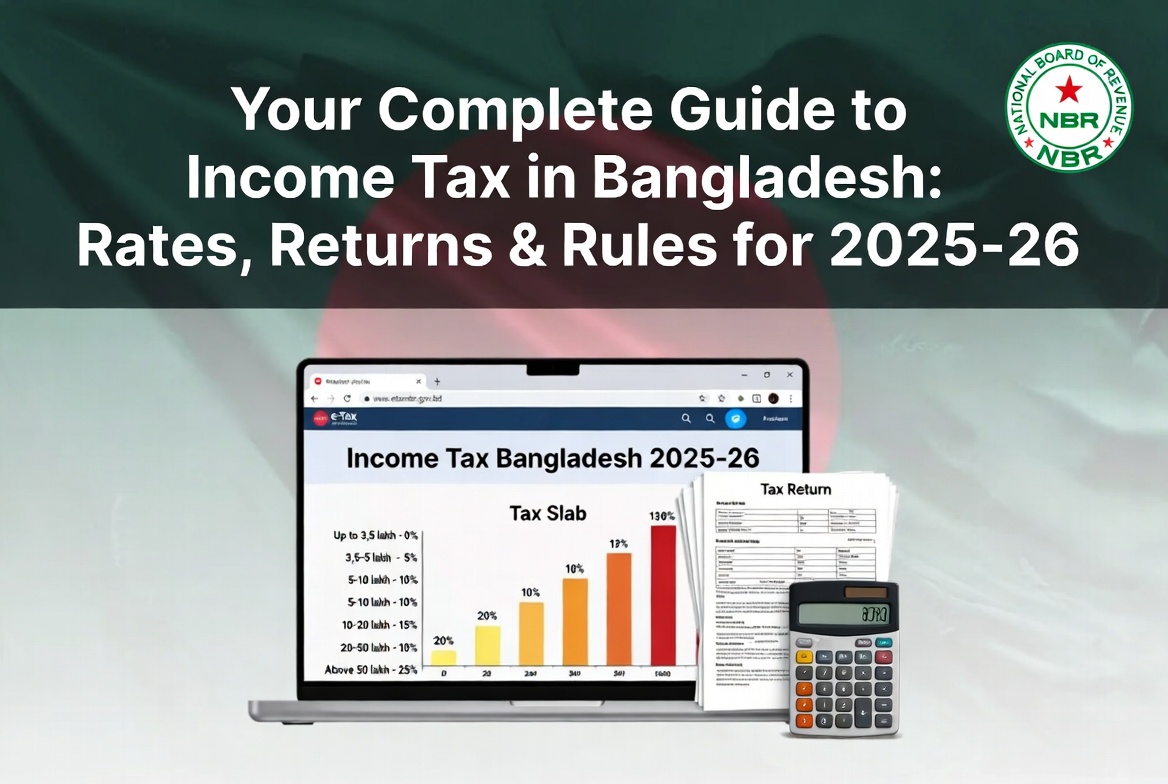
The Finance Ordinance, 2025 introduced a phased increase in tax-free thresholds. For AY 2025–26, the tax-free threshold is BDT 3,50,000, rising to BDT 3,75,000 for AY 2026–27 and 2027–28. The applicable income tax rates are:
- Up to BDT 3,50,000: Nil
- Next BDT 1,00,000: 5%
- Next BDT 4,00,000: 10%
- Next BDT 5,00,000: 15%
- Next BDT 5,00,000: 20%
- Remaining income: 25%
Non-resident individuals (other than non-resident Bangladeshis) are taxed at a flat rate of 30%.
-
Mandatory e-Filing for AY 2025–26
NBR has mandated that all individual taxpayers file income tax returns exclusively through its e-filing portal (www.etaxnbr.gov.bd), effective 4 August 2025. The mandatory e-filing requirement does not apply to taxpayers aged 65 or above, those with certified disabilities, Bangladeshi taxpayers residing abroad, legal representatives of deceased taxpayers, and foreign nationals working in Bangladesh — though these groups may still voluntarily e-file.
-
Advance Tax Obligations
Advance tax is required only where total income of the last assessed year exceeds BDT 6,00,000.
Taxpayers must pay advance tax in four equal instalments of 25% each, due by 15 September, 15 December, 15 March, and 15 June, based on estimated income for the financial year.
-
Minimum Tax and Carry Forward
Where a taxpayer’s regular tax liability falls below the minimum tax suffered under Section 163, the excess amount can be offset against surplus tax liability in a subsequent assessment year where regular tax exceeds minimum tax.
-
Conclusion
Bangladesh’s income tax framework has evolved significantly under the Income Tax Act, 2023 and the Finance Ordinance, 2025. Mandatory e-filing, updated tax brackets, and structured advance tax instalments reflect the government’s push toward a transparent, digitally driven tax administration. Taxpayers must ensure timely TIN registration, accurate return filing, and proper record maintenance to remain compliant and audit-ready.
References
- National Board of Revenue (NBR), Bangladesh. Overview of Tax Compliance.
- Grokipedia. “Taxation in Bangladesh.” February 2026.
- PwC Tax Summaries. “Bangladesh — Individual — Tax Administration.” December 2025.
- ACNABIN. “Summary of Important Changes Introduced by the Finance Ordinance, 2025.”
- Rahman Rahman Huq / KPMG Bangladesh. “Salient Features of Finance Ordinance 2025.” June 2025.
Disclaimer: This article is for educational and informational purposes only and does not constitute legal or tax advice. Always consult a qualified tax professional.