
Introduction
Value Added Tax (VAT) is Bangladesh’s most significant indirect tax, accounting for approximately 37.8% of total NBR revenue in FY 2025–26. Introduced on 1 July 1991 and comprehensively reformed through the VAT and Supplementary Duty Act, 2012, VAT touches every stage of production and distribution. For any business operating in Bangladesh, understanding VAT registration, return filing, invoice requirements, and input credit rules is essential for compliance and financial planning.
-
Structure and Background
Bangladesh’s VAT system was comprehensively reformed through the VAT and Supplementary Duty Act, 2012. The reform expanded coverage to include more services, simplified procedures, and introduced supplementary duties on luxury and demerit goods. The tax applies to imports, local manufacturing, and supplies, with input tax credits allowed to avoid cascading effects, ensuring only net value addition is taxed [1].
-
Standard VAT Rate and Reduced Rates
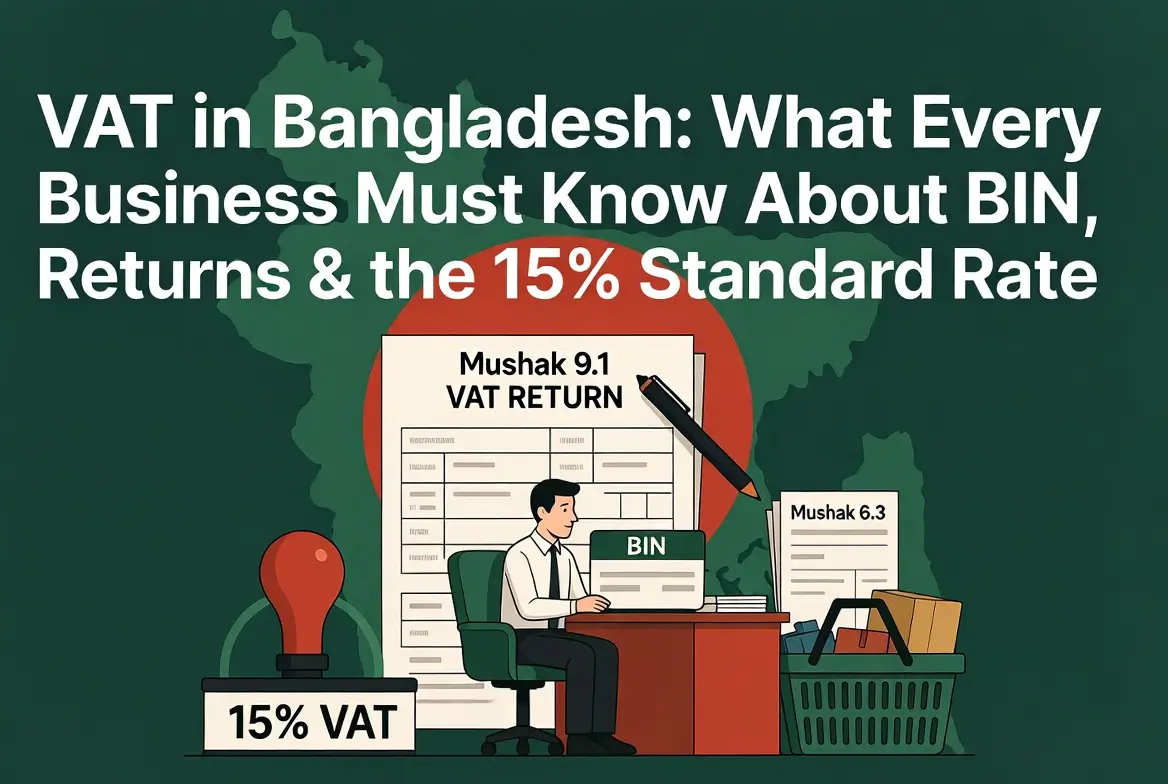
The standard VAT rate is 15%, applied to the taxable value of most goods and services unless exempted or subject to a reduced rate. Reduced rates of 5% apply to essentials like basic agricultural products. Supplementary duties apply to luxury and demerit goods such as tobacco and alcohol at varying rates [1].
-
VAT Registration — BIN and Threshold
Businesses must register for VAT and obtain a Business Identification Number (BIN) if annual turnover from taxable supplies exceeds BDT 30 lakh. VAT compliance then involves monthly or quarterly filings depending on turnover thresholds [1].
Under Finance Ordinance 2025, the VAT registration threshold does not apply to certain categories legally required to be registered regardless of turnover — ensuring high-risk sectors remain fully within the VAT net [2].
-
VAT Returns and Mushak Forms
VAT compliance is governed by standardised Mushak forms. Mushak 9.1 is used for filing VAT returns, while Mushak 6.3 is the format for tax invoices issued by registered businesses. Other Mushak forms cover VAT deduction at source, input-output coefficients, and supplementary duty declarations [3].
-
VAT Deduction at Source (VDS)
Certain government entities and specified organisations must deduct VAT at source (VDS) when paying suppliers and deposit it with the government. Suppliers can claim VDS certificates as input credit in their VAT returns but must maintain a proper tracker to chase missing certificates [4].
-
Input Tax Credit Rules (Updated 2025)
Under Finance Ordinance 2025, the input tax credit claim window has been extended from four to six subsequent tax periods after the purchase period. For goods cleared from customs using a bank guarantee, the six-period window begins from the date of encashing the guarantee or final settlement of taxes, whichever is later [2].
Input VAT attributable solely to exempt supplies is blocked and cannot be claimed as a credit. Businesses with mixed supply portfolios must maintain proper apportionment calculations [4].
-
VAT Exemption Authority Change
A key structural change under Finance Ordinance 2025 is that NBR is no longer authorised to issue general exemption orders for VAT-able goods, services, and imports. Only the government now holds the sole authority to issue VAT exemptions — reducing scope for ad hoc discretionary exemptions [5].
-
Special VAT Periods (2025)
Finance Ordinance 2025 introduced a semi-annual VAT period for construction companies, procurement providers, and clearing and forwarding agents — ending on 30 June and 31 December. This provision does not apply where such entities are themselves VAT withholding entities [2].
-
NBR’s Drive to Expand the VAT Base
NBR Chairman Md Abdur Rahman Khan has acknowledged that VAT registrations have not increased proportionately with business growth. NBR has set a target to bring at least 100,000 new businesses under the VAT system and has placed VAT registration at the centre of VAT Day and VAT Week activities. The Chairman reiterated the long-term goal of establishing a single unified VAT rate to simplify administration and eliminate competitive distortions [6].
-
Conclusion
Bangladesh’s VAT system is transitioning toward full digital administration, broader registration coverage, and tighter enforcement. Businesses must ensure correct registration, timely Mushak return filing, proper input credit trails, and complete VDS certificate tracking. The Finance Ordinance 2025 changes signal a maturing VAT regime that rewards compliance and reduces tolerance for leakages.
References
- Grokipedia. “Taxation in Bangladesh — VAT Section.” February 2026. https://grokipedia.com/page/Taxation_in_Bangladesh
- ACNABIN. “Summary of Important Changes Introduced by the Finance Ordinance, 2025.” https://bti-global.files.svdcdn.com
- OGR Legal Resource Portal. “Overview of Tax Compliance in Bangladesh: Income Tax & VAT.” https://resource.ogrlegal.com/tax/
- Tahmidur Rahman Remura Wahid (TRW). “NBR Tax & VAT Compliance.” February 2026. https://tahmidurrahman.com/nbr-tax-vat-compliance/
- Rahman Rahman Huq / KPMG Bangladesh. “Salient Features of Finance Ordinance 2025.” June 2025. https://assets.kpmg.com
- Bangladesh Sangbad Sangstha (BSS). “NBR Chairman Stresses on Expanding VAT, Income Tax Base.” December 9, 2025. https://www.bssnews.net/business/340128
Disclaimer: This article is for educational and informational purposes only and does not constitute legal or tax advice. Always consult a qualified tax professional.